• Free Quote
Scan2Archive
  • Home
  • About Us
  • Services
    • Document Scanning
    • Mail House Services
    • Plan Scanning
    • Microfilm Scanning
    • Professional Services Scanning
    • Office Relocation
    • Data Entry
    • Data and Document Conversion
    • Book Scanning
  • Quality & Security
  • Resources
    • Case Studies
    • Blog
    • FAQ
  • Contact Us
  • Menu Menu

3 IMPORTANT BENEFITS WHY YOUR BUSINESS SHOULD DIGITISE MICROFILM AND MICROFICHE

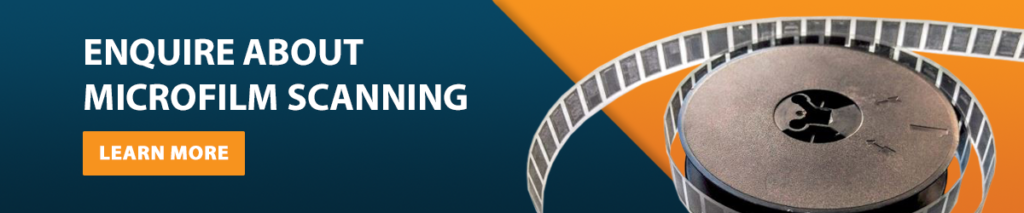
Converting your archives from physical microfilm and microfiche files to digital format will bring your data collection into the modern age. Microfilm and microfiche scanning services take away the challenges and headaches of what can otherwise be a daunting project. Engaging one can help your organisation reap the numerous benefits of updating your data from analogue to digital.

SAVE SPACE

Updating your microfilm and microfiche archives to digital files will allow your business to free up space and utilise a more efficient data management system. Long term preservation of microfilm and fiche require costly storage and proper handling techniques.

For example, reference copies of film and microfiche should be stored in a clean, dark, climate-controlled environment, preferably between 18 and 22 degrees Celsius. The room’s relative humidity should also be kept between 45 and 55. Since they’re sensitive to extended exposure to light, microfilm and fiche should be returned to their storage packaging immediately after use.

In contrast, a USB drive full of digitised microfilm and microfiche can easily replace entire rooms full of filing cabinets. While microfilm and fiche need expensive and hard to use specialised reading equipment, digitised files can be accessed using a computer.

Simply put, your organisation will become more efficient as digitising microfilm and microfiche records will allow you to eliminate the costs of storage, archiving, and searching for data.

SPEED UP DATA ACCESS

Microfilm digitisation also saves your organisation time. Information that would’ve otherwise taken hours or days to retrieve can be accessed in mere moments. Digitised documents can be processed with optical character recognition (OCR) software so they can be made searchable and then indexed into a database.

You can save the time and resources of having to train staff to use the specialised microfilm reader, then having them spend hours or days searching through rolls of microfilm. Instead, data from scanned microfilm can be accessed immediately through virtually any device.

BE PREPARED FOR THE UNEXPECTED

Unlike physical microfilm or microfiche, digital files can be copied many times over with little degradation from the original. These backup files can be stored anywhere.

For example, copies can be stored both on the original computer or on multiple computers within your office. This means that in case the original computer is damaged, then the files will still be accessible. A sound backup strategy can also include a mix of onsite, offsite or cloud-based backup locations.

This way, there’s less risk of losing valuable information unlike with physical files that are susceptible to fire, theft, damage or loss.

PROFESSIONAL MICROFILM SCANNING SERVICE

Once you decide that your organisation can reap the benefits that digitisation offers, then contact us at Scan2Archive. Our 20-years of industry experience lets us offer in-house microfiche scanning services backed by AS/NZS ISO 9001:2015 Quality Accreditation.

Our professional services utilise strict quality control processes to handle even degraded film and can restore these so that they can be scanned. Scan2Archive utilises dedicated high-resolution microfilm scanning equipment to convert your microfilm and fiche into digital files.

The utmost care is taken to ensure that your important records do not get damaged during the digitisation process. Scan2Archive’s FlexScan professional microfilm digitisation equipment utilises superior camera technology to produce uniform output at incredible speeds and precision. The resulting images are sharper with better edge definition because of the FlexScan’s use of fibre optic light sources which eliminates hotspots and uneven lighting.

Following scanning, image enhancement software and hardware can be applied to ensure maximum legibility and text search capability. You also have the option to process the images using optical character recognition (OCR) software. Finally, once digitised, you can decide whether to have the films returned or securely destroyed.

Contact our experts today so we can help your organisation bring your microfilm and microfiche archives into the digital age.

Latest Posts

  • Digital Mailroom Services For Australian Businesses
    What Is a Digital Mailroom and How Can It Benefit Your Business?July 10, 2026 - 11:05 am

    The Traditional Mailroom Is a Bottleneck Most businesses receive physical mail every day. Invoices, applications, contracts, correspondence, cheques, forms. Somebody has to collect it, open it, sort it, distribute it, and make sure it gets to the right person or system in a reasonable timeframe. For a long time, that process sat in a physical […]

  • Microfilm To PDF Conversion For Archives And Businesses
    Microfilm to PDF: What Businesses and Archives Need to KnowJuly 10, 2026 - 10:49 am

    A Format That Outlasted Expectations When microfilm was introduced as a records storage medium in the early twentieth century, it was a genuine innovation. A single reel could store thousands of document images in a fraction of the physical space of the originals. Libraries, banks, government agencies, newspapers and insurance companies adopted it widely. For […]

  • Secure Document Scanning Protects Sensitive Records
    How Secure Document Scanning Protects Sensitive RecordsJuly 10, 2026 - 10:21 am

    Why Document Security Cannot Be an Afterthought When an organisation decides to digitise its records, the conversation often starts with practical questions: how many documents, what format, how quickly? Security tends to come later in the discussion. Yet for many businesses and government bodies, the sensitivity of the records being scanned is precisely why they […]

  • outsourcing document scanning 2
    Why Getting the Groundwork Right Makes All the Difference When Outsourcing Document ScanningApril 17, 2026 - 10:45 am

    There’s a moment most organisations recognise: the filing system has outgrown the filing room, retrieval takes longer than it should, and a fully searchable digital archive starts to sound less like a luxury and more like a necessity. Outsourcing document scanning is often the most practical path forward, but the outcome depends heavily on how […]

info@scan2archive.com.au

1300 789 684

Servicing Australia Wide

Sydney

Central Coast

Melbourne

Brisbane

Canberra

All Offices are by Appointment Only

Company

FAQ

Contact Us

Scan2Archive acknowledges the Aboriginal and Torres Strait Islander peoples as Traditional Custodians of the land on which we work and live. We pay respect to Elders past, present and emerging.

TALK TO US

Contact us today for a FREE quote.
Our experienced and friendly team are available now to assist with your enquiry

ENQUIRE

Scan2Archive © Copyright - 2024 - Enfold WordPress Theme by Kriesi
  • Home
  • About Us
  • Services
  • Quality Control
  • Resources
  • Contact
Link to: PATIENTS’ MEDICAL RECORDS: SCAN2ARCHIVE’S MEDICAL RECORDS SCANNING GUARANTEES PRIVACY AND SECURITY Link to: PATIENTS’ MEDICAL RECORDS: SCAN2ARCHIVE’S MEDICAL RECORDS SCANNING GUARANTEES PRIVACY AND SECURITY PATIENTS’ MEDICAL RECORDS: SCAN2ARCHIVE’S MEDICAL RECORDS SCANNING GUARANTEES... Link to: 4 REASONS WHY DOCTORS SHOULD TRY A PROFESSIONAL MEDICAL RECORD SCANNING SERVICE Link to: 4 REASONS WHY DOCTORS SHOULD TRY A PROFESSIONAL MEDICAL RECORD SCANNING SERVICE 4 REASONS WHY DOCTORS SHOULD TRY A PROFESSIONAL MEDICAL RECORD SCANNING SER...
Scroll to top Scroll to top Scroll to top